
We often mistakenly talk about resilience as if it is a personality trait: some people have it, others do not. Neuroscience however tells a more hopeful story. The brain is not fixed. It changes, continuously, in response to what we repeatedly experience, practise and reinforce. That means resilience is not a trait you either have or lack; it is something the brain learns to do with practice.
Stress is one of the most powerful experiences shaping how the brain wires itself. And the brain is always learning from it. The question is, what is stress teaching your brain?
Stress is always teaching the brain something
When you sense pressure or threat, the brain does not simply "think harder." It activates a coordinated response.
The amygdala detects potential danger and signals the body to prepare. The insula tracks what is happening internally: a racing heart, tightened chest, shallow breathing. The prefrontal cortex, responsible for planning, perspective and decision-making, works to interpret the situation and choose a response.
Under acute stress, this system is genuinely useful. It sharpens focus, mobilizes energy, and creates a sense of urgency. The body is doing exactly what it evolved to do.
But when stress responses fire repeatedly without adequate recovery, the brain gets faster and more efficient at reacting. The threshold for detecting a threat drops. The prefrontal cortex, where clear thinking and emotional regulation live, comes online less readily. Research on chronic stress points to measurable changes in the density of connections in the prefrontal cortex and increased sensitivity in the amygdala, the brain's threat-detection system. This is why someone who is chronically overloaded starts finding it harder to think clearly, regulate their reactions, or make considered decisions.
None of this means stress is inherently bad. It means stress is always training the brain. What matters is the direction of that training.
The brain can rewire. That is the point.
Neuroplasticity is the brain's capacity to change and reorganize itself based on experience. Every thought, reaction, behaviour and recovery practice we repeat strengthens particular neural pathways. This is why habits become automatic, why skills feel effortless with enough practice, and why certain responses to pressure start to feel like "just who I am."
But that automatic quality was learned, and it can be retrained.
If the brain repeatedly experiences "pressure means panic," that pathway becomes well-worn and easier to travel. If the brain repeatedly experiences "pressure means pause, notice, interpret, respond," that pathway can become stronger.
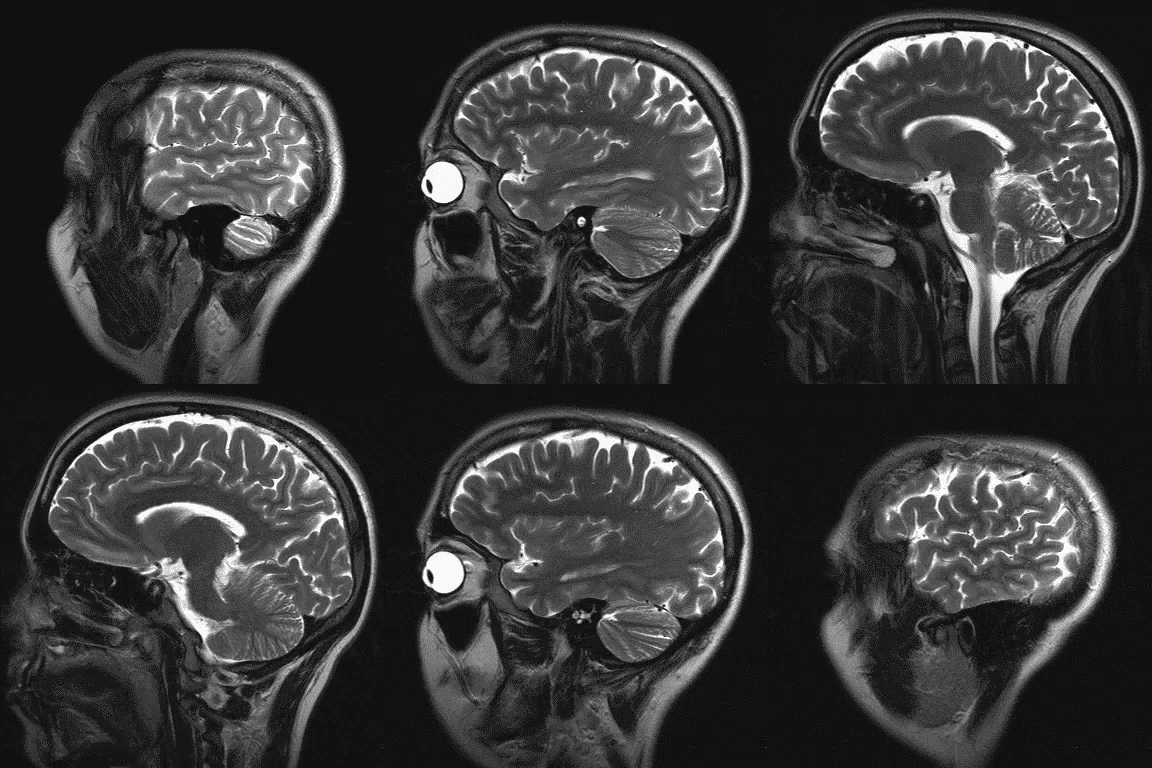
Studies using neuroimaging have found that people who regularly practise cognitive reappraisal, deliberately reinterpreting a stressful situation rather than reacting to it, show greater prefrontal engagement and reduced amygdala reactivity when they reappraise, and that this pattern tends to strengthen with regular practise.
Every time you meet pressure with a steadier response instead of a reaction, you make that response easier to find next time. That's what building resilience actually is: repetition, not willpower.
Resilience is what the brain learns through repeated adaptive responses
This reframes resilience in an important way. Rather than treating it as simply bouncing back, resilience becomes about adaptation: the brain gradually getting better at moving from reaction to response.
In other words, resilience is a set of practised neural habits. Each time someone notices a stress signal early, understands what it is signalling, and chooses a response that supports recovery or forward movement, they are strengthening a new pathway. Not dramatically or all at once, but incrementally through repetition.
This is why small practices carry more weight than they appear to. A pause before sending a difficult message, a short walk after an intense meeting, or a deliberate reframe before a high-stakes presentation.
These actions may feel minor in the moment. Repeated consistently, they teach the brain something important: pressure does not have to mean threat. It can mean information.
Stress intelligence helps guide what the brain practices
Neuroplasticity can work in either direction. Without awareness, the brain can become more practised at reactive, survival-mode responses: narrowing attention, bracing for threat, pushing through without recovery. With stress intelligence, it can learn a different set of habits.
At WONE, stress intelligence (SQ) is built around three steps:
Notice. Notice the signal before it takes over. What is your body, behaviour or thinking showing you? A tight jaw, a shortening of patience, a drop in concentration, the urge to push through?
Interpret. Understand what the signal means. Is this the good pressure of a challenge you are capable of meeting? Fatigue that needs recovery? Uncertainty asking for clarity? Fear asking for support? The quality of your response depends on the accuracy of your interpretation.
Respond. Choose what the moment actually needs. Action, rest, movement, a clearer boundary, a conversation, a reframe, time to think. Not the default. The deliberate choice.
This is the loop that, practised repeatedly, builds resilience. A brain that has learned, through experience, how to meet pressure with something more useful than panic or avoidance.
Try this: train the pause
The next time you feel stress rising, resist the pull to fix everything immediately. Instead, create a small gap between signal and response.
Tune in and notice one signal.
Name what might be happening: "My system is under load." "I am reading this as a threat." "I am running low on recovery."
Choose one adaptive response. A few slow breaths, a short walk, or writing down the next single step. Maybe waiting before you reply.
This loop becomes a practice. The more often you practice it, the more naturally the brain reaches for it.
The brain is always learning from stress.
Without awareness, it may learn survival patterns: react faster, narrow attention, brace for threat, push through, withdraw. With stress intelligence, it can learn something different: how to notice earlier, respond more wisely, recover more fully, and build resilience over time.
That is the power of neuroplasticity.