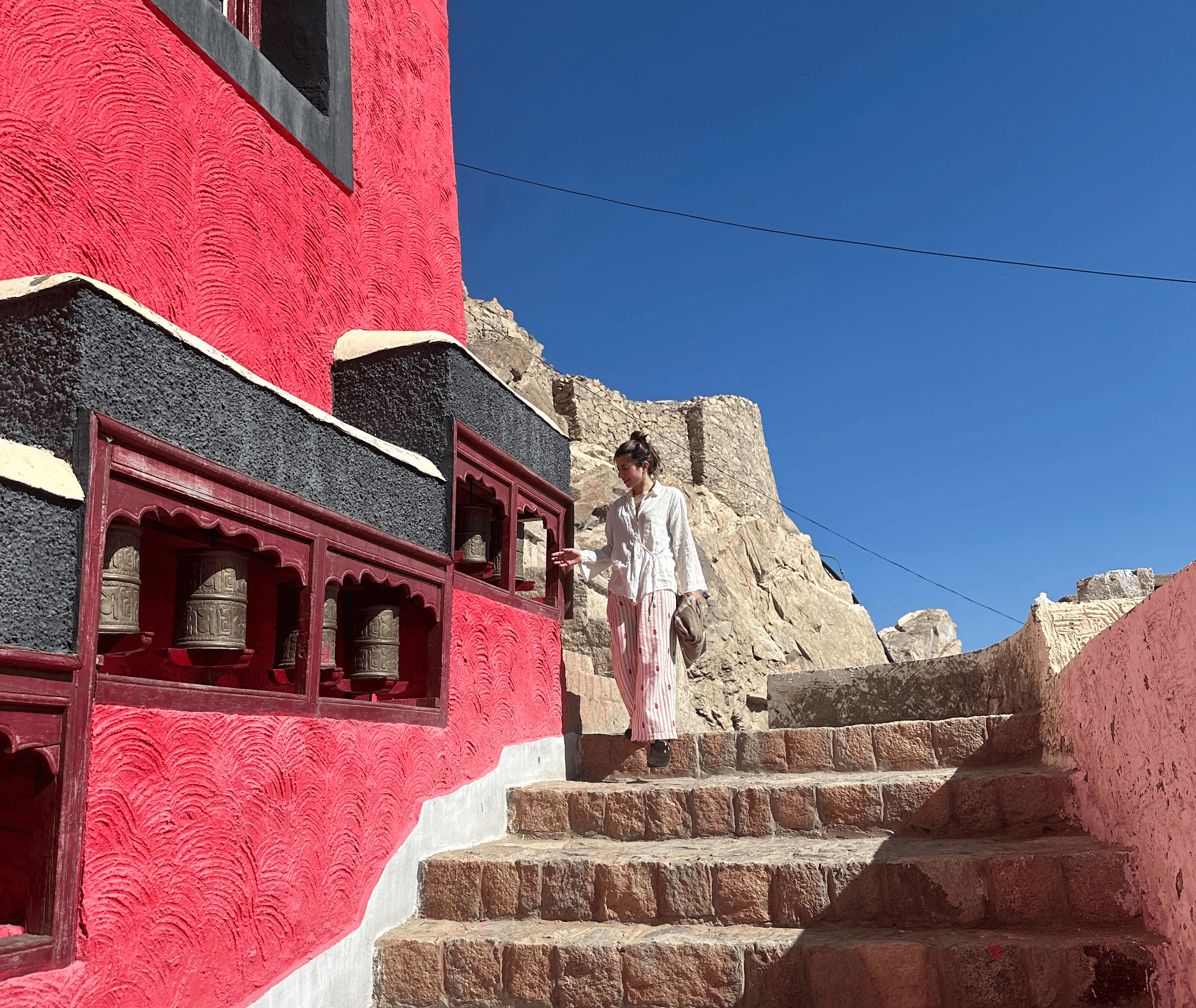
I received an important lesson in Thiksey monastery in Ladakh, India. Truth reveals itself in the pauses. In the moments when we stop ‘doing’, when we get away from the noise and create space to listen to our body’s signals. Counterinuitively, often the fastest way to move forward is to take a pause.
The illusion of speed
We are living through a once in a generation technological shift. The AI wave will deliver 10x velocity, 10x productivity, 10x impact. As a founder, the possibility excites me deeply. It’s why I released an AI Manifesto for the team at WONE last year calling for a new era of the company.
But as I watched how companies are racing to adopt AI, testing all the new tools, chasing efficiency and constantly trying to stay one step ahead, I couldn’t help but feel a niggling discomfort that we are missing the point. Everyone is accelerating pace to move faster but are getting lost in the noise of constant alerts, updates and new discoveries. As Seneca warned, it's not life that is short, but that we waste it in busyness.
I noticed this pattern mirrored in myself. There’s so much I want to do with my company, and especially now with the AI wave but I was overcommitted and split across too many priorities. My energy was diluted. I knew the most responsible thing to do for both my health and my company’s success was not to ‘do’ more but to ‘be’. To stop chasing the next advancement and create the space for wisdom to emerge.
Choosing stillness as a strategy
I pushed myself to go against what I've been conditioned to believe around working hard to achieve success. I took an intentional break to connect back to my body’s signals and my inner wisdom.
I spent 5 days at Thicksey Monastery in the Himalayas, 3,500m above sea level. Not a holiday filled with activities. Not a retreat with a rigid schedule. But the space of nothingness. Silence, nature, no digital connection. I let go of the need to fill my time with ‘busyness’.
This combination allowed me to shut out all the noise in the world around me, everyone else’s opinions and conditioning, and allowed me to focus on my body’s signals.
I joined the monks for morning prayers, went for long walks, sat in the monastery, read and wrote. It filled me with renewed conviction, understanding and clarity. I simplified the lessons I learnt into the following three themes:
Lesson one: Inner wisdom is your competitive advantage
What do Bill Gates, Steve Jobs, Oprah Winfrey and the Dalai Lama all have in common? They attribute no small part of their success to their spiritual practice. Steve Jobs asked for the Autobiography of the Yogi to be given out at his memorial because it’s the book that had the greatest impact on his life. Why? Because we are the source of what we create in this world. If we want to be leaders who create a huge impact in the world through products that have never been seen before, we must first cultivate the inner wisdom that gives us the awareness to see the world differently and the courage to act on that inner knowing.
Dr Gabor Mate once shared that when visiting palliative care units, the most common life regret he heard from those in the ward was not having the courage to be who they truly are. They suppressed who they were and what they wanted to be because of what they thought they should do or be. That insight stayed with me. It’s why at WONE, authenticity is our number one value. Being authentic in everything we do, acting with integrity and being unapologetic about our mission and how we show up to solve it. I believe that if you act authentically, from the heart, you can never really fail because you’ve stayed true to what you believe is right.
One of the monks, Chamba, who’d lived at Thiksey for decades said quietening the mind is vital for tapping into that source of inner knowing and cultivating the courage to realise it. And that’s exactly what I found. Through just 5 days of sitting in stillness, I felt my intuition sharpening. Decisions that had felt heavy became clear. My creativity and ideas started flowing. The mental noise, the ‘what ifs’, the second guessing clouding my vision fell away. I made a commitment to find stillness when back in the city, quietening my mind every day, even if just for 5-10 minutes, to protect my decision making power.
Lesson two: Purpose reframes stress
Society often talks about stress as something to eliminate. But the answer is much more nuanced. When you are deeply connected to why you do what you do, effort feels different. You are in flow. You wake up excited, time stops and work becomes a calling, not a career.
Chamba shared his story of how he runs the monastery whilst being the founder of three charities. His days are full, demanding and sometimes stressful. Yet he smiled as he spoke with a sense of lightness. He said that because his work is aligned with his purpose, the stress is good stress because it feels so rewarding.
This lesson is a powerful one for us to remember. Counterintuitively, the goal is not to find work-life balance, we know this notion is flawed. Instead, we should seek to find our flow in everything we do in life. As Robert Henri so beautifully puts it “The object isn't to make art, but to be in that wonderful state which makes art inevitable".
Lesson three: Build an environment that allows you to flourish
The final lesson is on the importance of environment, who you surround yourself with and where you do it. “If I sit in a university library,” the monk said, “surrounded by people studying, I naturally want to study too.” It’s why I chose to go to a monastery in Ladakh to find solitude, instead of staying in my house in London. It’s a simple truth, backed by research: we become like the environments and people we immerse ourselves in.
For businesses, this underscores the importance of building the right team and culture. At WONE, we combine a strong work ethic, high bar on excellence and creative drive with passion, empathy and joy; experiencing the wonder of walking on earth each day together. This intersection is our competitive advantage. It also means being radically honest with the team about the environment you’re operating in and giving fast feedback when expectations aren’t met. You can’t separate performance from wellbeing and values; when you lead with integrity, performance follows.
Close
Chamba shared a Tibetan adage for stress: ‘stress is like drinking salty water, you keep drinking to free your thirst but it doesn’t quench and only deepens your thirst.’
We’re so stuck in ‘doing’ and so stressed in that doing that we’re unable to release from the vicious cycle and notice the trap. We’re so afraid to pause because of the fear of being left behind that we miss the very signals our body is giving us.
Today, we’re more stressed than ever before. We’re sicker than ever before. The AI wave is only exacerbating that stress not because AI is ‘bad’ but because we’re not approaching it in the right way. Adopting AI is a powerful force multiplier but to do so effectively we must set a new standard.
This is a defining moment to radically rethink the way we work, how we lead and use AI as a partner in that rewiring. The scale of the world’s health epidemic demands it.
This next era of leadership calls for intentionality. From this place of intentionality comes bold thinking, relentless curiosity, staying true to values and staying firm to the belief that excellence happens when you are in tune with your body’s signals and respond intelligently.
Prev
Stress Intelligence and the Wisdom to Respond Well
Dr. Amit Sood has studied stress from ICU wards to boardrooms. His conclusion: stress alone doesn't break people. Unexamined response does. This conversation explores how wise leaders interpret stress and respond to it with clarity and intention.

How Stress Reshapes Decision-Making, and What Leaders Can Do Earlier
When time feels scarce, judgement shifts. In this SAB conversation, Harvard’s Ashley Whillans explores how stress reshapes leadership decisions, and how Stress Intelligence protects sustainable performance.